MIC's ¥21.9 Trillion FY2027 Budget Request, Program by Program
The Ministry of Internal Affairs and Communications has requested ¥21.92 trillion for FY2027, but 95.8% of it is the transfer that funds local governments. MIC's own policy budget is about ¥886 billion, made up of ¥382 billion of regular spending and a new ¥503 billion investment framework that takes the place of last year's autumn supplementary, leaving it flat against last year. An interactive, program-by-program deep dive into where it goes: 6G and satellite optical communications, the All-Photonics Network, quantum, AI, subsea cables, cybersecurity, and the municipal digitization and My Number renewal wave.
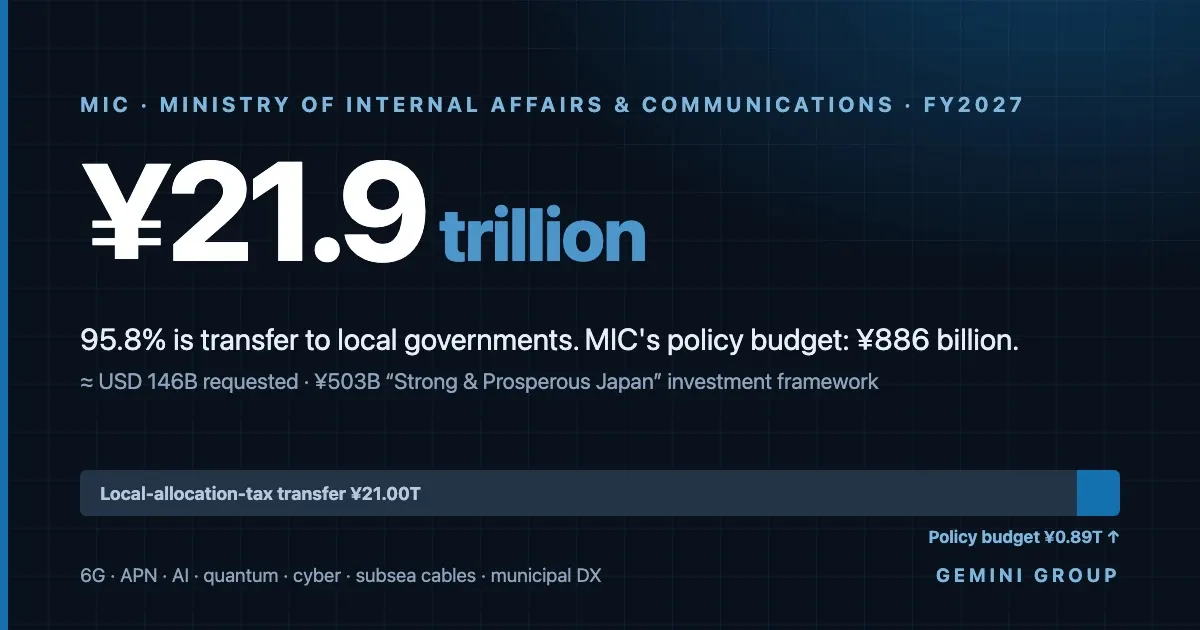
The Ministry of Internal Affairs and Communications has requested ¥21.92 trillion (~USD 146 B) for fiscal 2027, up 3.0%, but almost none of it is MIC’s to spend. 95.8% of the request, ¥21.0 trillion, is the transfer that funds the local allocation tax for prefectures and municipalities. MIC’s own policy budget, the part that pays for networks, AI, cybersecurity and digital government, is about ¥886 billion: ¥382 billion of regular discretionary spending plus ¥503 billion in the new “Strong & Prosperous Japan” investment framework. And against last year’s initial budget plus its autumn supplementary, that policy budget is flat, up about 1%: the new ¥503 billion “Strong & Prosperous Japan” investment framework almost exactly replaces the ¥528 billion MIC received in last year’s supplementary.
This is the second in our series of ministry deep dives behind Japan’s record ¥143 trillion FY2027 budget requests, after METI’s ¥7.8 trillion request. MIC matters to any company in telecoms, broadcasting, data centers, cybersecurity or government IT: it regulates the airwaves and networks, and it funds the digitization of Japan’s roughly 1,700 municipalities.
Explore the breakdown below: where the ¥21.9 trillion actually goes, the real change in MIC’s policy budget, its priority areas, and the programs that will open from April 2027 if funded. Toggle EN/JA at the top-right of the viewer.
Interactive visualization built on official Ministry of Internal Affairs and Communications data (August 2026). Yen-to-USD at ¥150 = US$1 for illustration.
What this tells you
- Total request: ¥21.92 tn (~USD 146 B), up ¥647 bn (3.0%) on the FY2026 initial budget, plus unpriced item-only requests.
- Almost all of it is a pass-through: ¥21.0 tn (95.8%) is the local-allocation-tax transfer to prefectures and municipalities. It is formula-driven, and MIC does not direct how it is spent.
- MIC’s own policy budget is about ¥886 bn, split into ¥382 bn of regular discretionary spending and ¥503 bn in the investment framework. It is flat: up about 1% against last year’s ¥350 bn initial budget plus ¥528 bn supplementary.
- The investment framework replaces the supplementary: ¥503 bn, 57% of the ¥886 bn policy budget (not on top of it), and almost exactly the size of last year’s autumn package. Several programs that existed only in last year’s supplementary now move into the regular budget.
- Networks lead: next-generation wireless (¥132 bn), the All-Photonics Network (¥50 bn), quantum (¥29 bn), watt-bit data centers (¥26 bn) and a new subsea-cable line.
- Municipal digitization is the second pillar: My Number Card renewals (¥118 bn) and local-government system standardization (¥76 bn).
The ¥21.9 trillion MIC doesn’t really spend
MIC is the ministry through which Tokyo funds local government. The local allocation tax (地方交付税) is a formula-based transfer that equalizes revenue across Japan’s prefectures and municipalities, and it flows through MIC’s general account: ¥20.997 trillion requested for FY2027, up ¥120 billion, with the amount actually delivered to local governments rising to ¥21.06 trillion. It is politically important, since it underwrites every local service in the country, but it is not a lever a company can engage on program by program.
Strip it out, along with ¥34 billion of pensions, and what is left is MIC’s policy budget of about ¥886 billion. That is the number to read. MIC presents it as ¥382 billion of regular discretionary spending plus ¥503 billion in the new investment framework, and compares it with last year’s ¥350 billion initial policy budget plus a ¥528 billion supplementary. Counted that way, MIC’s policy spending is essentially unchanged. What has changed is timing and certainty: money that used to arrive in the autumn, after the budget was set, is now in the initial budget, where programs can be planned around it.
Networks: 6G, photonics, quantum, data centers and subsea cables
The largest share of MIC’s policy money goes to communications infrastructure, grouped under a pillar on AI-era networks and economic security. In this and the following sections, each program shows the FY2027 request, then its FY2026 initial budget and, where MIC published one, its FY2025 supplementary allocation.
- Next-generation wireless (¥131.8 bn; FY2026 initial ¥61.8 bn, FY2025 supplementary ¥57.0 bn): R&D toward Beyond 5G/6G spectrum standards and the commercialization of satellite optical communications, including a nationwide network of optical ground stations.
- The All-Photonics Network (APN) (¥50.0 bn, all in the investment framework; FY2026 initial none, FY2025 supplementary ¥21.4 bn): R&D and deployment testing for all-optical networks.
- Quantum communications (¥28.8 bn; FY2026 initial ¥2.2 bn, FY2025 supplementary ¥23.2 bn): real-environment trials of quantum-key distribution and R&D toward a quantum network around 2040.
- Watt-bit distributed data centers, 5G and fiber (¥26.5 bn; FY2026 initial ¥4.2 bn, FY2025 supplementary ¥5.2 bn): trials of regionally distributed data centers linked to power supply, and subsidies for fiber and base stations in remote areas. This is MIC’s side of the watt-bit strategy we cover in our piece on data center regulation in Japan.
- Subsea cables (¥2.5 bn plus an item-only request; new, no prior-year funding): support for a domestic fleet to lay and maintain cables, multi-routing, hardened landing stations and cable protection. The small number understates the intent; item-only requests are where the real figure is settled later.
Overseas, the FOIP Digital Corridor program (¥33.5 bn; FY2026 initial ¥0.37 bn, FY2025 supplementary ¥8.1 bn) backs Japanese companies building subsea cables, 5G/6G and optical networks abroad, and pushes Japanese AI into overseas markets. Alongside the budget, MIC proposes strengthening JICT, its overseas ICT and postal investment fund, with ¥78 bn of industrial investment and ¥20 bn of guaranteed borrowing.
AI, cybersecurity and the information space
- Vertical AI and AI-trust evaluation (¥66.5 bn, all in the investment framework; FY2026 initial none, FY2025 supplementary ¥38.3 bn): AI built for the communications sector to address labor shortages in network operations, and an active evaluation platform for testing AI trustworthiness, with evaluation datasets.
- Cybersecurity (¥23.0 bn across the area): ¥8.7 bn to train cyber talent through NICT against threats from misuse of frontier AI (FY2026 initial ¥1.6 bn, FY2025 supplementary ¥1.5 bn), ¥6.6 bn for AI-based defense and threat intelligence (FY2026 initial ¥2.1 bn), and ¥5.5 bn for a new consultation and shared-defense setup for local governments, including supply-chain risk (FY2026 initial ¥0.08 bn, FY2025 supplementary ¥4.0 bn).
- Mis- and disinformation (¥6.8 bn; FY2026 initial ¥0.95 bn, FY2025 supplementary ¥2.5 bn): countermeasures, organizational response and talent development against generative-AI-driven falsehoods online.
- Broadcasting (¥4.4 bn; FY2026 initial ¥4.3 bn): study of the future of broadcasting as audiences fragment across platforms, a live policy question for broadcasters and streaming services.
- Content abroad (¥15.0 bn; FY2026 initial ¥0.26 bn, FY2025 supplementary ¥2.8 bn): support for large-scale live-action drama production and for Japanese streaming platforms expanding overseas.
Municipal digitization and the My Number renewal wave
MIC’s second-largest area, about ¥194 billion, funds the digital transformation of local government. My Number Card renewal support (¥117.7 bn; FY2026 initial ¥29.8 bn, FY2025 supplementary ¥69.7 bn) helps municipalities staff their counters for the wave of card renewals now due. Municipal information-system standardization (¥75.6 bn; FY2026 initial ¥0.31 bn, FY2025 supplementary ¥55.9 bn) pays for local governments’ migration to standard-compliant systems, the program that sits alongside the Digital Agency’s Government Cloud. A new ¥720 million line pilots AI agents and end-to-end automation in municipal administration, and a new ¥10.2 bn “regional AX” track inside the Local 10,000 program funds AI adoption by regional businesses. MIC also requests ¥12.7 bn for communications infrastructure for autonomous driving (FY2026 initial ¥0.38 bn, FY2025 supplementary ¥0.50 bn), with a proposed fixed-asset-tax measure for the 5G equipment used to monitor autonomous vehicles remotely.
Rounding out the request: ¥20.8 bn for fire and disaster response (including wildfire equipment and AI, robots and drones for the fire service), ¥17.2 bn to harden mobile base stations and cable TV against disasters, ¥19.1 bn for statistics and administrative operations, and ¥30.8 bn of party subsidies.
How to read MIC’s request
- Ignore the headline, read the policy budget. ¥21.0 trillion of the ¥21.9 trillion is a formula-driven transfer. The decisions that matter to companies sit in the ¥886 billion.
- Watch what moves from the supplementary into the regular budget. The APN, AI evaluation, quantum and municipal standardization were largely supplementary-funded last year. In the regular budget they become steadier, multi-year and easier to plan around.
- Treat the item-only requests as signals. Subsea cables, CBRNE response in the fire service and the base-grant increase all carry unpriced components. Those are where the final numbers will be settled, and where there is still room to make a case.
- Act on two horizons. For FY2027, align projects with the named programs and prepare for calls that open from April 2027. To shape how a program is designed, engage MIC’s councils and study groups, which set up the budget after this one.
Gemini Group tracks MIC’s budget cycle, councils and study groups, filtered to what bears on each client’s sector, and advises on both capturing the programs this request signals and shaping the ones still being written. Contact us to discuss what MIC’s FY2027 request means for you.
Figures are converted from MIC’s published units of ¥100 million (億円) and rounded, so components may not sum exactly to totals. Figures in ¥ billion are shown to one decimal (two below ¥1 billion) where precision matters, and to the nearest billion elsewhere.
Further reading: our breakdown of METI’s FY2027 request, the overview of Japan’s full FY2027 budget requests, our guide to registering a telecommunications business in Japan, and our overview of Japan’s Digital Agency.
Frequently asked questions
- How much is MIC requesting for FY2027?
- The Ministry of Internal Affairs and Communications (MIC, 総務省) has requested ¥21.92 trillion (令和9年度概算要求, ~USD 146 billion) in the general account for fiscal 2027, up ¥647 billion or 3.0 percent on its FY2026 initial budget, plus item-only requests that carry no number yet. The headline is misleading on its own: ¥21.0 trillion of it, 95.8 percent, is the transfer that funds the local allocation tax for prefectures and municipalities.
- Why is MIC's budget so large?
- Because MIC is the ministry through which the national government funds local governments. The local allocation tax (地方交付税) is a formula-driven transfer that equalizes revenue across prefectures and municipalities, and it passes through MIC's general account. MIC administers it but does not direct how local governments spend it. Stripping it out, along with pensions, leaves MIC's own policy budget of about ¥886 billion.
- Is MIC's policy spending actually increasing?
- Barely. Against the FY2026 initial budget alone (¥350 billion of policy spending), the ¥886 billion request looks like a two-and-a-half-fold jump. But last year MIC also received ¥528 billion through the autumn supplementary budget. Adding it gives a combined ¥877 billion, against which the FY2027 request is up about 1 percent. The new ¥503 billion 'Strong & Prosperous Japan' investment framework is, in effect, last year's supplementary money requested up front.
- What is MIC spending its policy budget on?
- Mostly networks and digital government. The largest programs are next-generation wireless, Beyond 5G/6G and satellite optical communications (¥132 billion), support for My Number Card renewals (¥118 billion), municipal information-system standardization (¥76 billion), vertical AI and an AI-trust evaluation platform (¥66 billion), the All-Photonics Network (¥50 billion), the FOIP Digital Corridor and Japanese AI overseas (¥33 billion), quantum communications (¥29 billion) and distributed 'watt-bit' data centers, 5G and fiber (¥26 billion).
- What is MIC doing on subsea cables?
- It has a new line for autonomous subsea-cable capability: ¥2.5 billion plus an item-only request to support a domestic fleet for laying and maintaining cables, multi-routing, hardened landing stations and cable protection. Separately, the FOIP Digital Corridor program (¥33.5 billion) backs Japanese companies building subsea cables, 5G/6G and optical networks overseas, framed explicitly as economic security.
- Does MIC's request include AI and misinformation measures?
- Yes. MIC requests ¥66.5 billion for vertical AI in the communications sector and an active evaluation platform for AI trustworthiness, ¥6.8 billion to counter online mis- and disinformation (up from ¥950 million in the FY2026 initial budget), ¥8.7 billion to train cybersecurity talent against threats from misuse of frontier AI, and ¥560 million for AI governance, including the Hiroshima AI Process.
- Are there tax or investment measures alongside MIC's budget request?
- Yes. MIC is seeking a new fixed-asset-tax special measure for nationwide 5G equipment used to remotely monitor autonomous vehicles, and it proposes strengthening the risk-money capacity of JICT, the Fund Corporation for the Overseas Development of Japan's ICT and Postal Services, through ¥78 billion of industrial investment and ¥20 billion of government-guaranteed borrowing in the fiscal investment and loan program.
- When does the FY2027 budget become final?
- MIC submitted its request at the end of August 2026. The Ministry of Finance reviews it through the autumn, the Cabinet typically approves a draft budget in late December, and the Diet passes it before the fiscal year begins on 1 April 2027.