Japan's Record ¥143 Trillion Budget Requests, Ministry by Ministry (FY2027)
For FY2027, Japan's ministries have requested a record ¥143.07 trillion, the first time budget requests have topped ¥130 trillion. An interactive, ministry-by-ministry breakdown of the 概算要求: who is asking for what, where the increases are, and the new 'Strong & Prosperous Japan' investment framework.
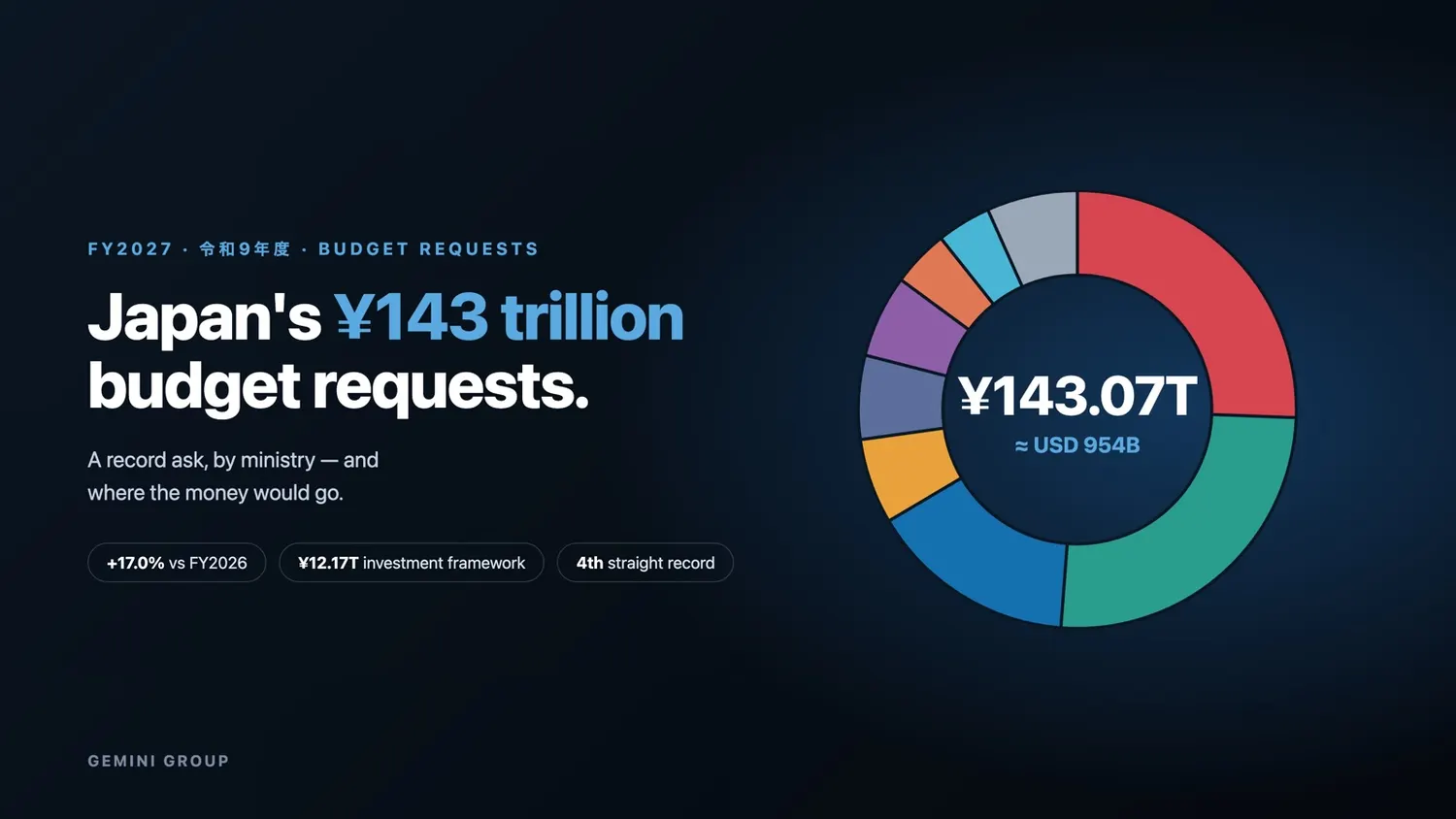
Japan’s ministries have requested a record ¥143.07 trillion (~USD 954 B) for fiscal 2027 (令和9年度), the first time budget requests have ever topped ¥130 trillion, and the fourth straight record. Requests are up 17.0% on the FY2026 budget, pushed by Prime Minister Takaichi’s uncapped “Strong & Prosperous Japan” investment framework, a surge in debt-service costs as interest rates normalize, and ever-growing social security.
These are the 概算要求 (gaisan yōkyū): the opening bids each ministry submits at the end of August, before the Ministry of Finance reviews them through the autumn and the Cabinet finalizes the budget in December. They are the earliest, widest public read on where the government wants to spend next year.
Explore the full ministry-by-ministry breakdown below: every ministry’s request, how much more each is asking for than this year’s budget, and where the new investment-framework money is concentrated. Toggle EN/JA at the top-right of the viewer.
Interactive visualization built on official Ministry of Finance data (September 4, 2026). Yen-to-USD at ¥150 = US$1 for illustration.
What this tells you
- Total requests: ¥143.07 tn (~USD 954 B), a record, and the first time over ¥130 tn.
- Up 17.0% on the FY2026 budget of ¥122.3 tn.
- The new investment framework: ¥12.17 tn under the uncapped “Strong & Prosperous Japan” envelope, the single biggest reason requests broke past ¥130 tn.
- Debt service: ¥36.64 tn, the fastest-growing line, up 17.1%, as the assumed interest rate rises with BOJ normalization.
- Biggest ministries: Health, Labour and Welfare ¥36.58 tn (social security); Internal Affairs and Communications ¥21.92 tn (mostly the ¥21.0 tn local allocation tax); Land, Infrastructure and Transport ¥8.96 tn; Defense ¥8.84 tn (costed items only); Education and Science ¥8.78 tn.
- Biggest jumps vs the FY2026 budget: METI (the investment framework: AI, semiconductors), Education and Science, Digital Agency, Environment, and Land/Infrastructure/Transport.
- A new agency: the Disaster Management Agency (防災庁) appears as its own line for the first time.
How close is this to the final budget?
Closer than the word “request” suggests. In recent years the Cabinet budget has landed within a fraction of a percent of what the ministries asked for: last year, FY2026 requests totaled ¥122.4 trillion, and the budget that followed came in at ¥122.3 trillion, a reduction of about 0.1 percent. The Ministry of Finance reviews every line through the autumn and adjusts at the margins, but the overall shape, and each ministry’s priorities, largely hold. The one component more likely to move this year is the uncapped “Strong & Prosperous Japan” investment framework, which is new and has no ceiling to discipline it.
That is what makes the requests worth reading closely, but it also reframes what to do about them. They are not a wishlist that gets halved before it becomes law; they are a near-final picture of where FY2027 money is heading, published in early September. For most organizations, the value is not in trying to change these numbers, that contest is largely upstream, settled months earlier in the ministry councils and in the ceiling that sets the request rules, but in seeing clearly where the money is about to flow and positioning to align with it: the subsidies, programs, and priorities that will unlock in the fiscal year beginning next April. Shaping the numbers is a next-cycle exercise, begun long before the requests are public. Capturing what this cycle has already decided starts now, with the requests in hand.
The 17% overstates it: the supplementary-budget shift
There is a catch in that 17 percent increase, and it changes how the number should be read. Japan’s real annual spending is not just the initial budget (当初予算) passed each spring. It is the initial budget plus the supplementary budgets (補正予算) added mid-year, which have been large: roughly ¥13.9 trillion in FY2024 and ¥18.3 trillion in FY2025.
For FY2027, the government has changed the instruction. The Ministry of Finance’s request guidelines, the “Basic Policy 2026” (基本方針2026), explicitly tell ministries to “break free from supplementary-budget dependence and record permanent measures in the initial budget.” In other words, spending that in past years would have arrived through an autumn supplementary is now being requested up front, inside the initial budget. Part of the ¥143 trillion is not new spending; it is existing spending pulled into view. The clearest embodiment is the investment framework itself: at ¥12.17 trillion, it is nearly the size of a recent supplementary budget, now requested up front.
That makes a straight initial-to-initial comparison misleading. A fairer benchmark adds a supplementary to last year’s initial budget. Take FY2026’s ¥122.3 trillion initial budget and add a supplementary of the size Japan actually ran in FY2025 (¥18.3 trillion), and you reach roughly ¥140.6 trillion, the comparison analysts have adopted. Against that, the FY2027 request of ¥143.07 trillion is only about 1.8 percent higher, not 17 percent.
Both statements are true, and both matter. Real spending growth is far more modest than the headline suggests. But the structural change is significant: more of Japan’s spending is being pulled into the transparent, scrutinized initial budget rather than fast-tracked through supplementaries that get far less debate. For anyone tracking a specific program, that shift means the initial budget, and therefore these requests, now capture more of the real picture than they used to.
What has changed since last year’s budget
When the finalized FY2026 budget passed, we broke it down in detail. Set against that ¥122.3 trillion budget, three things stand out in the FY2027 requests:
- Debt service keeps climbing, fast. It was ¥31.28 trillion in the FY2026 budget; ministries are now requesting ¥36.64 trillion, over ¥5 trillion more, as the assumed interest rate rises with the Bank of Japan’s normalization. It is the clearest continuation of last year’s story, and the reason discretionary room keeps shrinking.
- Social security keeps growing. Health, Labour and Welfare alone requests ¥36.58 trillion, of which roughly ¥33.7 trillion is social security (pensions, medical, and long-term care) and only about ¥2.9 trillion is the ministry’s other work (employment, labour, and public health). Together with debt service, social security remains the gravitational center of the budget, the two lines that grow structurally whatever else happens.
- The supplementary shift is genuinely new. Last year’s real spending was an initial budget plus an expected supplementary. This year’s request is an initial budget built to absorb what the supplementary used to carry, which is why it looks so much larger even though real growth is modest.
- The investment framework is a supplementary in all but name. The new “Strong & Prosperous Japan” framework is worth ¥12.17 trillion, close to a full supplementary budget in its own right: Japan ran a ¥13.9 trillion supplementary in FY2024 and ¥18.3 trillion in FY2025. It is, in effect, a supplementary’s worth of spending requested up front inside the initial budget, which is both why the headline jumped and why the real increase, measured against last year’s budget plus a supplementary, is small.
How to read a 概算要求
- Watch the requests, not just the budget. The request is the earliest signal of intent, and in recent years a close preview of the budget that follows, months before it is fixed.
- Separate the capped requests from the uncapped framework. The base requests sit under a ceiling; the “Strong & Prosperous Japan” investment framework (投資枠, or toushiwaku) has none, so a large share of the increase sits there. Where a ministry has placed its investment-framework requests tells you its real priorities for the year.
- Follow debt service and social security first. Together they are the gravity of the budget: they grow structurally and squeeze everything discretionary.
- Note what is understated. Defense makes item-only (事項) requests that carry no number yet, so its costed figure understates the real ask. Some investment-framework money also sits in special accounts.
- Act on two horizons. For FY2027, the numbers are largely set, so the move now is to position to align with and capture the funding these requests signal, the subsidies and programs that unlock from next April. To shape the numbers themselves, engage earlier in the cycle, in the councils and the request ceiling that precede the requests, for the budget after this one.
Gemini Group tracks the budget cycle from the councils and the request ceiling through to Cabinet approval, filtered to what bears on each client’s issues, and advises both on capturing the funding these requests signal and on engaging earlier in the cycle to shape the budgets still to come. Contact us to discuss what the FY2027 requests mean for you.
Further reading: our detailed breakdown of the finalized FY2026 budget, and our guide to the Japan policy calendar and when in the cycle to engage.
Frequently asked questions
- How big are Japan's FY2027 budget requests?
- Japan's ministries have requested a record ¥143.07 trillion for the FY2027 (令和9年度) general account, up 17.0 percent on the FY2026 budget of ¥122.3 trillion. It is the first time budget requests (概算要求) have topped ¥130 trillion, and the fourth consecutive record. These are requests rather than the final budget, but in recent years the two have been very close: the Ministry of Finance reviews the requests from September and the Cabinet finalizes the budget in December, typically within a fraction of a percent of the total requested.
- What is a 概算要求 (budget request)?
- The 概算要求 (gaisan yōkyū) is the budget request each Japanese ministry submits to the Ministry of Finance at the end of August for the fiscal year beginning the following April. It is the earliest public signal of where each ministry wants to spend, and the widest point in the budget funnel. MOF then reviews and adjusts the requests through the autumn, the Cabinet approves a draft budget in late December, and the Diet passes it by the end of March. In recent years the final budget has stayed close to the requests, so this is where the priorities that will actually be funded are first visible.
- Do Japan's final budgets change much from the requests?
- Not much in recent years. The Ministry of Finance reviews every request and adjusts at the margins, but the totals and each ministry's priorities largely carry through to the Cabinet budget. For FY2026, ministries requested ¥122.4 trillion and the budget came in at ¥122.3 trillion, about 0.1 percent lower. The main exception this year is the uncapped 'Strong & Prosperous Japan' investment framework, which is newer and less disciplined than a normal request line, so it is the component most likely to be trimmed. In general, though, the requests are a close preview of the budget, not a wishlist.
- Which ministry requested the most in FY2027?
- Excluding national debt service (¥36.64 trillion, which is not a ministry), the largest single request is the Ministry of Health, Labour and Welfare at ¥36.58 trillion, driven by pensions, medical, and long-term care. The Ministry of Internal Affairs and Communications follows at ¥21.92 trillion, most of which is the ¥21.0 trillion local allocation tax grant to prefectures and municipalities. Then come Land/Infrastructure/Transport (¥8.96 trillion), Defense (¥8.84 trillion on a costed basis), and Education/Science (¥8.78 trillion).
- What is the 'Strong & Prosperous Japan' investment framework?
- It is a new, uncapped priority spending envelope (『「強く豊かな日本」投資枠』) introduced under Prime Minister Takaichi for FY2027, worth ¥12.17 trillion across the general account. Unlike a normal request line, it has no ceiling, which is a major reason total requests jumped past ¥130 trillion. The Ministry of Economy, Trade and Industry dominates it, requesting ¥4.5 trillion in the general account for AI, semiconductors, and industrial priorities, with a further ¥1.8 trillion in the energy special account.
- Is Japan's FY2027 spending really 17% higher than FY2026?
- Not in real terms. The 17 percent figure compares the FY2027 request to the FY2026 initial budget alone. But Japan's actual spending each year is the initial budget plus mid-year supplementary budgets, which have been large (about ¥18.3 trillion in FY2025). For FY2027 the government has instructed ministries to move supplementary-type spending into the initial budget, so part of the increase is spending relocated, not added. Compared to the FY2026 initial budget plus a FY2025-size supplementary (about ¥140.6 trillion), the FY2027 request of ¥143.07 trillion is only around 1.8 percent higher. The headline overstates real growth, but the shift toward putting more spending in the transparent initial budget is itself significant.
- Why is Japan's debt-service cost rising so fast?
- National debt service (国債費) is the fastest-growing item, requested at a record ¥36.64 trillion, up 17.1 percent on the FY2026 budget. The driver is Japan's return to positive interest rates: as the Bank of Japan normalizes policy and the assumed interest rate rises, the cost of servicing the debt stock climbs even without new borrowing, squeezing the room for everything else.
- When is Japan's FY2027 budget finalized?
- The requests are submitted at the end of August. The Ministry of Finance reviews them through the autumn, negotiating with ministries and the ruling party. The Cabinet typically approves a draft budget in late December, and the Diet deliberates and passes it before the fiscal year begins on 1 April. The stretch from September to Cabinet approval in December is when the remaining adjustments are made, but the major allocations are largely decided by the time the requests are public. Shaping the numbers is mostly an earlier-cycle exercise; acting on the funding they signal starts now.