Japan's ¥122.3 Trillion Budget, In Detail (FY2026)
Japan's national budget is a record ¥122.3 trillion for FY2026, up ¥7.1 trillion. The full revenue and expenditure breakdown, why social security and debt service consume 57 percent of it, and what bond dependency of 24.2 percent means.
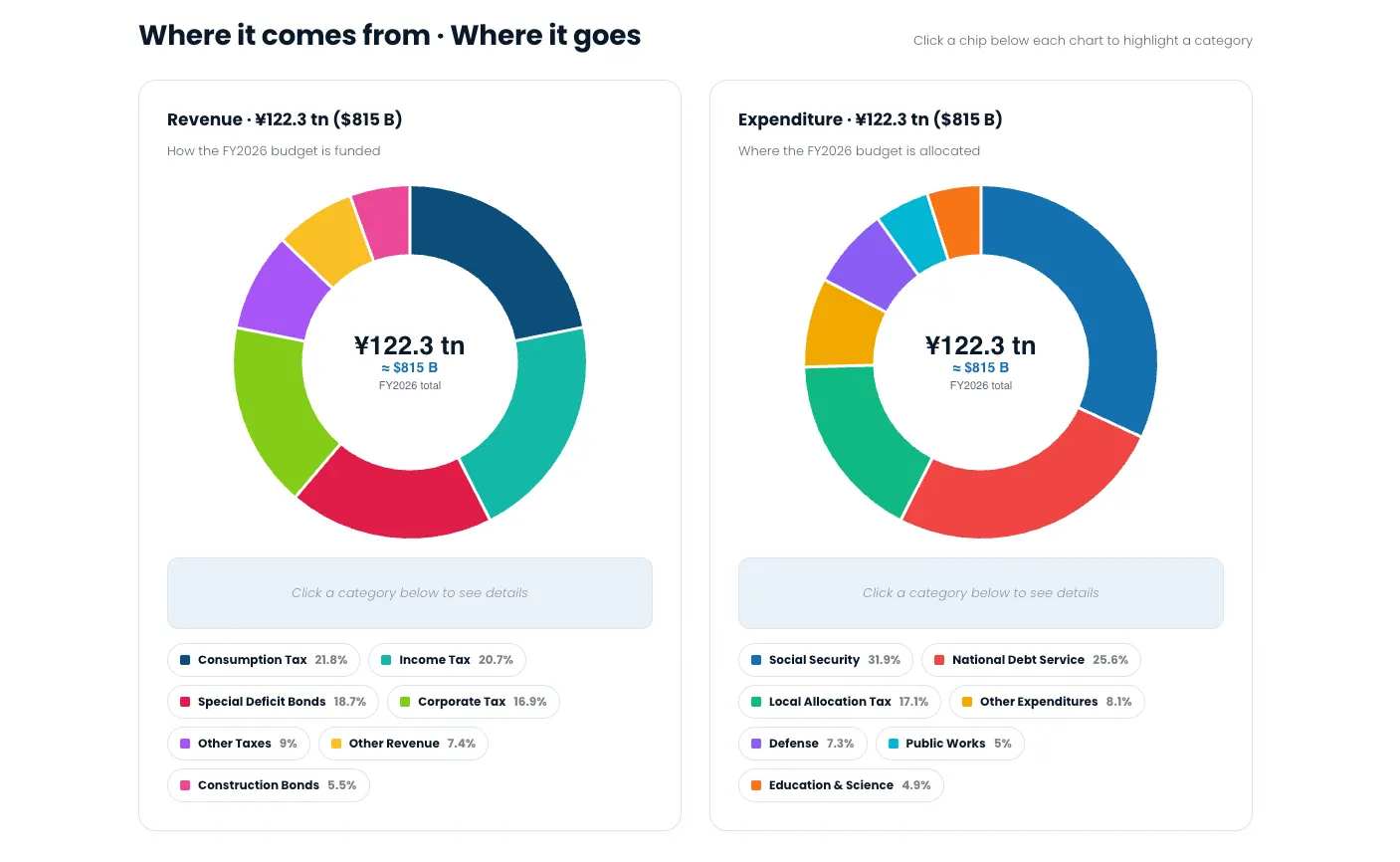
The Cabinet’s FY2026 (令和8年度) general account budget reached a record ¥122.3 trillion ($815 B), up ¥7.1 trillion ($47 B) from FY2025. Interest payments are surging, social security is expanding, and new free-education programs are coming online. Record tax revenue funds most of it; new bond issuance stays below ¥30 trillion for the second straight year.
Explore the full interactive breakdown below: revenue sources, spending categories, year-over-year changes, a half-century of fiscal history, and the rapidly growing debt-service line item. Toggle EN/JA at the top-right of the viewer.
Interactive visualization built on official Ministry of Finance data. Yen-to-USD at ¥150 = $1 for illustration.
What this tells you
- Total budget: ¥122.31 tn (~$815 B), the largest in Japanese history.
- Tax revenue: ¥83.74 tn (~$558 B), record high, funding ~68% of the budget.
- New bond issuance: ¥29.58 tn (~$197 B), bond dependency at 24.2%.
- Debt service: ¥31.28 tn (~$208 B), the fastest-growing line item, as the assumed rate moves from 2.0% to 3.0%.
- Key spending bets: Defense (¥8.81 tn), children and childcare (¥3.20 tn), free education (¥0.70 tn), green transformation / GX (¥0.70 tn), semiconductors and AI (¥1.20 tn), medical fee revision (+3.09%).
How big is Japan’s national budget?
Japan’s national budget, meaning the general account, is ¥122.3 trillion for FY2026. That is a record, up ¥7.1 trillion on the previous year.
One clarification matters here, because the phrase “Japan’s budget” is used loosely. The figure quoted in news coverage is almost always the general account. Japan also runs special accounts (特別会計), which ring-fence money for specific purposes such as pensions and debt redemption. Their combined gross total exceeds the general account, but because funds move between accounts, the net figure is considerably smaller. Comparing a special account gross total against the general account is a common and misleading error.
Revenue breakdown, FY2026
Tax revenue reaches ¥83.7 trillion, a record, funding roughly 68 percent of the budget.
| Source | Amount | Share |
|---|---|---|
| Consumption tax | ¥26.69 tn | 21.8% |
| Income tax | ¥25.33 tn | 20.7% |
| Special deficit bonds | ¥22.87 tn | 18.7% |
| Corporate tax | ¥20.70 tn | 16.9% |
| Other taxes and stamp revenue | ¥11.03 tn | 9.0% |
| Other revenue | ¥8.99 tn | 7.4% |
| Construction bonds | ¥6.72 tn | 5.5% |
Consumption tax now raises more than income tax, which is a structural feature of the Japanese system rather than a one-year artefact. New bond issuance, combining special deficit and construction bonds, totals ¥29.59 trillion, putting bond dependency at 24.2 percent. Roughly a quarter of the budget is borrowed.
Expenditure breakdown, FY2026
| Category | Amount | Share |
|---|---|---|
| Social security | ¥39.06 tn | 31.9% |
| National debt service | ¥31.28 tn | 25.6% |
| Local allocation tax grants | ¥20.88 tn | 17.1% |
| Other expenditures | ¥9.97 tn | 8.1% |
| Defense | ¥8.98 tn | 7.3% |
| Public works | ¥6.11 tn | 5.0% |
| Education and science | ¥6.04 tn | 4.9% |
The structure is stark. Social security and debt service alone account for about 57 percent of the budget. Add local allocation grants and three lines consume roughly 75 percent, leaving discretionary policy spending confined to the remaining quarter. This is the single most important fact about Japanese fiscal policy for anyone seeking funding: the room to manoeuvre is small, and it is contested every August.
Debt service is the line to watch. It rose from ¥28.22 trillion to ¥31.28 trillion, an increase of more than ¥3 trillion. That is not simply a larger debt stock. The assumed interest rate used to build the budget moved from 2.0 percent to 3.0 percent. As Japan returns to a world with positive rates, interest costs rise even where the stock does not, and they crowd out everything else in the discretionary quarter.
If you would like to learn more about Japan’s FY2026 budget allocations and explore how your business can take advantage of emerging opportunities, please get in touch.
Frequently asked questions
- How big is Japan's national budget?
- Japan's general account budget is ¥122.3 trillion for FY2026, a record, up ¥7.1 trillion on the previous year. This general account figure is what news coverage normally means by Japan's budget. Japan separately operates special accounts that ring-fence money for purposes such as pensions and debt redemption, whose gross total is larger but whose net figure is considerably smaller once transfers between accounts are excluded.
- What is the breakdown of Japan's revenue?
- For FY2026: consumption tax ¥26.69 trillion (21.8 percent), income tax ¥25.33 trillion (20.7 percent), special deficit bonds ¥22.87 trillion (18.7 percent), corporate tax ¥20.70 trillion (16.9 percent), other taxes and stamp revenue ¥11.03 trillion, other revenue ¥8.99 trillion, and construction bonds ¥6.72 trillion. Total tax revenue is a record ¥83.7 trillion, funding roughly 68 percent of the budget.
- What is the breakdown of Japan's spending?
- Social security ¥39.06 trillion (31.9 percent), national debt service ¥31.28 trillion (25.6 percent), local allocation tax grants ¥20.88 trillion (17.1 percent), other expenditures ¥9.97 trillion, defense ¥8.98 trillion (7.3 percent), public works ¥6.11 trillion, and education and science ¥6.04 trillion. Social security and debt service together account for about 57 percent of all spending.
- What is the difference between Japan's general account and special accounts?
- The general account covers the state's core revenue and spending and is the figure normally quoted as the national budget. Special accounts ring-fence money for specific programmes such as pensions, debt redemption and fiscal investment. Their combined gross total exceeds the general account, but funds move between accounts, so the net total is much smaller. Comparing a special account gross figure with the general account is a common error.
- How much of Japan's budget is funded by debt?
- New bond issuance for FY2026 is ¥29.59 trillion, giving a bond dependency ratio of 24.2 percent. Roughly a quarter of the budget is borrowed. This is the second consecutive year that new issuance has stayed below ¥30 trillion, which record tax revenue has made possible.
- Why is Japan's debt service cost rising?
- Debt service rose from ¥28.22 trillion to ¥31.28 trillion, an increase of over ¥3 trillion. The driver is not only a larger debt stock: the interest rate assumed when building the budget was raised from 2.0 percent to 3.0 percent. As Japan returns to positive interest rates, servicing costs climb even without new borrowing, squeezing the roughly one quarter of the budget that is genuinely discretionary.