METI's ¥7.8 Trillion FY2027 Budget Request, Program by Program
The Ministry of Economy, Trade and Industry has requested a record ¥7.79 trillion for FY2027. Against last year's budget plus its autumn supplementary, the fair comparison, that is up about 48%, not the doubling a bare initial-budget number implies, with 81% of it in the new uncapped 'Strong & Prosperous Japan' investment framework. An interactive, program-by-program deep dive into where METI wants to put industrial money next year: AI and semiconductors, economic security, GX, content, and the SME schemes opening from April 2027.
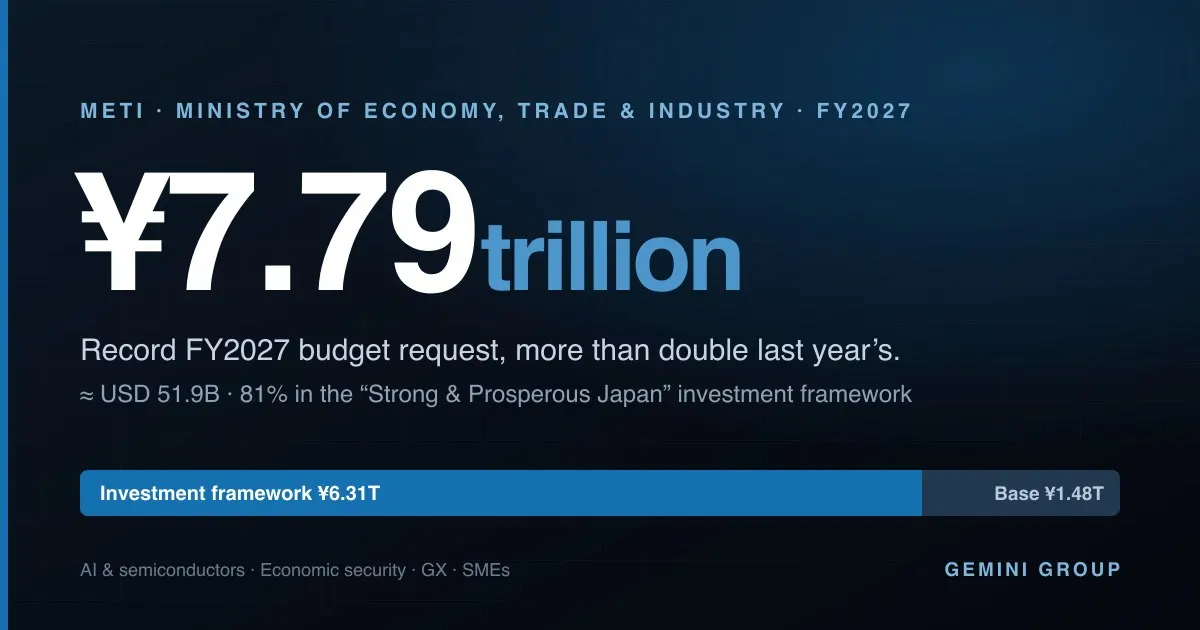
The Ministry of Economy, Trade and Industry has requested a record ¥7.79 trillion (~USD 51.9 B) for fiscal 2027, the largest request it has ever made. On paper that is more than double its ¥3.07 trillion FY2026 initial budget, but that comparison flatters it. METI’s real spending each year is the initial budget plus a large autumn supplementary (about ¥2.2 trillion in FY2025), so the fairer benchmark is roughly ¥5.3 trillion combined, against which the request is up about 48%. That is still a striking jump, and the clearest single expression of Prime Minister Takaichi’s industrial agenda: 81% of it, ¥6.31 trillion, sits in the new, uncapped “Strong & Prosperous Japan” investment framework, concentrated in AI and semiconductors, economic security, and GX.
This is the first in a series of Gemini Group deep dives into the individual ministries behind Japan’s record ¥143 trillion FY2027 budget requests. We start with METI because it is the ministry closest to industry, and because its request moved more than any other: the investment framework has swollen METI’s 概算要求 into a ¥7.8 trillion statement of intent about which sectors the government will back with money next year.
Explore the full breakdown below: METI’s eight priority areas, how much of each rides on the investment framework, and the flagship programs, many new or sharply scaled up, that will open from April 2027 if funded. Toggle EN/JA at the top-right of the viewer.
Interactive visualization built on official Ministry of Economy, Trade and Industry data (August 31, 2026). Yen-to-USD at ¥150 = US$1 for illustration.
What this tells you
- Total request: ¥7.79 tn (~USD 51.9 B), a record. Against the FY2026 budget plus a FY2025-size supplementary (≈¥5.3 tn), the fair comparison, it is up about 48%; a bare initial-budget number (¥3.07 tn) overstates it as a doubling.
- The investment framework dominates: ¥6.31 tn, 81% of the request, sits in the uncapped “Strong & Prosperous Japan” envelope. METI is its single largest user.
- AX (AI, semiconductors, robotics) is the biggest priority: ¥1.99 tn, of which roughly ¥1.4 tn is AI and robotics. The single largest program is a ¥896 bn multimodal AI foundation-model effort aimed at “physical AI.”
- Economic security surges: ¥1.55 tn, up from just ¥43 bn in the FY2026 budget, a roughly 36-fold jump, led by ¥529 bn for mineral-resource supply chains and ¥219 bn for chemical supply-chain resilience.
- GX and energy stay large: ¥1.98 tn across next-generation reactors, hydrogen, GX supply chains, and clean-energy vehicles.
- SMEs get a big envelope: ¥1.38 tn to strengthen small and mid-size firms’ “earning power,” including a ¥220 bn successor to the monozukuri (manufacturing) subsidy.
The number that doubled, and what it really means
Read literally, METI’s request looks explosive: ¥7.79 trillion against a ¥3.07 trillion initial budget, up more than 150%. That number needs the same caution as the headline for the whole budget: the fair comparison adds last year’s autumn supplementary to last year’s initial budget. METI’s FY2026 initial budget (¥3.07 trillion) plus a FY2025-size supplementary (about ¥2.2 trillion) is roughly ¥5.3 trillion; against that, the FY2027 request is up about 48%, not 150%. Most of the increase is the ¥6.31 trillion investment framework, and the framework is doing two things at once.
First, it is pulling supplementary-budget spending forward. In past years, a large share of METI’s real annual spending did not come from the initial budget at all; it arrived in the autumn supplementary. METI’s FY2025 supplementary was about ¥2.2 trillion. The government’s FY2027 request guidelines tell ministries to record permanent measures in the initial budget rather than lean on supplementaries, so spending that would previously have been added mid-year is now requested up front. Part of the ¥7.79 trillion is not new money; it is existing money moved into view.
Second, it is genuinely new industrial investment, especially in AI, semiconductors, and economic security, tied to the government’s medium-term goal of mobilizing large-scale public-private investment through 2030 and beyond.
Both are true. The honest read is that METI’s request represents a real, deliberate step-up in industrial spending, but a smaller one than “more than doubled” implies, layered on top of a structural shift toward putting that spending in the transparent initial budget. For anyone tracking a specific scheme, that shift matters: the initial budget, and therefore this request, now captures more of the real picture than it used to.
AX: the AI, semiconductor and robotics bet
METI’s largest priority is what it now calls AX, AI, semiconductors and robotics, at about ¥1.99 trillion. The framing is deliberate: METI is grouping foundation models, robotics, and semiconductors into one integrated push, betting that Japan’s edge lies in “physical AI”, AI applied to real-world environments like manufacturing, logistics, care, disaster response, and nuclear decommissioning, rather than in frontier language models alone.
The flagship programs:
- Multimodal foundation-model development (physical AI): ¥896 bn, up from ¥387 bn, the single largest line in the entire request.
- AI robotics strategy program: ¥321 bn (new) and an AI-robotics core-hub program: ¥133 bn (new).
- Post-5G information and communications systems R&D: ¥371 bn, the semiconductor and advanced-computing base (down from ¥674 bn as some spending shifts).
- Semiconductor design and manufacturing base: ¥91 bn, plus a ¥32 bn IPA equity injection to underwrite debt guarantees for next-generation chipmakers. METI is separately reported to be seeking around ¥150 bn for Rapidus through the Innovation Platform Agency.
- Decommissioning physical-AI R&D: ¥47 bn (new), applying remote and autonomous technology to nuclear cleanup.
Alongside the costed lines, METI has made item-only (事項要求) requests, carrying no number yet, for mass-production investment, R&D, and social implementation in AI, semiconductors and robots, signalling that the real AI-and-chips ask is larger than the printed figure.
Economic security: a 36-fold jump
The area that grew most in proportional terms is economic security and the defense industrial base: ¥1.55 trillion, up from just ¥43 billion in the FY2026 budget. This is where the geopolitics of supply chains lands in the budget.
- Mineral-resource development and supply-chain stabilization: ¥529 bn (from ¥7.5 bn), plus ¥139 bn in dedicated critical-mineral stable-supply support, aimed at securing rare earths and other inputs for domestic manufacturing.
- Chemical supply-chain resilience: ¥219 bn (new), targeting naphtha diversification and midstream chemical stockpiles.
- Battery, aircraft-parts, and space-industry base strengthening, each a new investment-framework line.
- Medical-device and drug-discovery ecosystem support, reflecting METI’s move into securing domestic capacity for critical medical goods.
METI has also flagged item-only requests for economic-security equity and debt guarantees for strategically important startups, and for dual-use technology and production base strengthening, coordinated with the Ministry of Defense, an area to watch as the defense-industrial strategy takes shape.
GX, energy, the SME engine, and the end of Cool Japan
Two large, familiar blocks round out the request, alongside one smaller but symbolically sharp move.
Resource energy and GX (¥1.98 trillion) keeps Japan’s decarbonization-and-supply-security machine funded: next-generation advanced reactors (¥141 bn), GX supply-chain development (¥113 bn), hydrogen price-gap support (¥66 bn), energy-saving and non-fossil conversion investment (¥211 bn), and clean-energy vehicle subsidies (¥110 bn). Much of the base energy work sits in the energy special account rather than the framework, which is why this area carries the largest non-framework portion of any priority.
Small and mid-size firms (¥1.38 trillion) is the domestic-economy engine, built around the government’s “earning power” and wage-growth agenda. The centerpiece is a ¥698 bn expansion of the SME Base Infrastructure Organization grant and a ¥220 bn successor to the monozukuri and business-restructuring subsidy (新事業進出・ものづくり補助), one of the most widely used business subsidies in Japan, plus a ¥100 bn regional-cluster supply-chain formation subsidy. For any company with a Japanese manufacturing or SME footprint, these are the schemes most likely to be directly usable.
Content, and the end of Cool Japan. A smaller but symbolically sharp move sits in the ¥173 bn content-industry area. Its centerpiece, the Content Industry Growth Investment program (¥165 bn, up from ¥0.55 bn), arrives as the government looks to scrap the Cool Japan Fund, the public-private equity vehicle launched in 2013 that ran up roughly ¥54 billion in losses and drew years of criticism for backing companies with little to do with content. With the Fund dropped from the FY2027 fiscal investment-and-loan plan, METI is pivoting from taking equity stakes to grant-based, project-level support for pushing Japanese content and IP overseas, part of a goal to grow content’s overseas sales toward ¥20 trillion by 2033. For rights holders and studios, both the vehicle and the terms are changing.
How to read METI’s request
- Separate the framework from the base. Four-fifths of the request is the uncapped investment framework. Where METI has placed its framework money, and where it has instead made item-only requests, tells you its real priorities and where the numbers are still soft.
- Follow the named programs, not just the totals. METI’s request names specific schemes with specific amounts. In recent years those have largely carried through to the budget, so the program list is a near-final map of what will be fundable from April 2027.
- Watch the item-only requests. The unpriced 事項要求 lines, in AI mass production, economic-security finance, dual-use, and innovative drugs, are where the request understates the eventual ask. They are signals of intent worth tracking through the autumn.
- Act on two horizons. For FY2027, the schemes are largely set, so the move now is to align a project with a named program and position to use it when it opens. To shape a program’s terms, or to argue for a new line, engage earlier in the cycle, in METI’s councils and the request guidelines, for the budget after this one.
Gemini Group tracks METI’s budget cycle from the industrial-strategy councils and the request guidelines through to Cabinet approval, filtered to what bears on each client’s sector, and advises both on capturing the schemes this request signals and on shaping the programs still being written. Contact us to discuss what METI’s FY2027 request means for you.
Further reading: our overview of Japan’s full FY2027 budget requests, our breakdown of the finalized FY2026 budget, and our guide to the Japan policy calendar and when in the cycle to engage.
Frequently asked questions
- How much is METI requesting for FY2027?
- The Ministry of Economy, Trade and Industry (METI) has requested a record ¥7.79 trillion (令和9年度概算要求, ~USD 51.9 billion) for fiscal 2027. On paper that is more than double its ¥3.07 trillion FY2026 initial budget, but the fairer benchmark adds last year's autumn supplementary: the FY2026 initial budget plus a FY2025-size supplementary is roughly ¥5.3 trillion combined, against which the request is up about 48 percent. The figure spans the general account, the energy special account, and the patent special account. The jump is driven almost entirely by the new, uncapped 'Strong & Prosperous Japan' investment framework, which accounts for ¥6.31 trillion, about 81 percent of the total request.
- What is METI spending the money on?
- METI's request concentrates on a handful of strategic priorities. The largest is AX (AI, semiconductors and robotics) at about ¥1.99 trillion; then economic security and the defense industrial base at ¥1.55 trillion (critical minerals, chemicals, supply-chain resilience); resource energy and GX at ¥1.98 trillion; and the drive to strengthen small and mid-size firms' 'earning power' at ¥1.38 trillion. Flagship line items include a ¥896 billion multimodal AI foundation-model program, ¥529 billion for mineral-resource supply chains, and a ¥220 billion successor to the monozukuri (manufacturing) subsidy.
- What is the 'Strong & Prosperous Japan' investment framework?
- It is a new, uncapped priority-spending envelope (『「強く豊かな日本」投資枠』) introduced under Prime Minister Takaichi for FY2027. Because it has no ceiling, it lets ministries request far more than the normal budget rules allow. METI is the single largest user of it: ¥6.31 trillion of METI's ¥7.79 trillion request sits inside the framework, concentrated in AI and semiconductors, economic security, and GX. It is the main reason METI's request more than doubled year on year.
- Is METI's spending really more than double last year's?
- In headline terms, yes: ¥7.79 trillion requested versus a ¥3.07 trillion FY2026 initial budget. But the comparison overstates real new spending. The ¥6.31 trillion investment framework folds in spending that in past years arrived through mid-year supplementary budgets, plus genuinely new industrial investment. The framework alone is close to a full supplementary budget's worth of money, now requested up front in the initial budget rather than added in the autumn. The structural shift, more spending moved into the transparent initial budget, is real, but the increase is not all fresh money.
- Which METI subsidies open in FY2027?
- If funded as requested, the schemes that open from April 2027 include the successor to the monozukuri and business-restructuring subsidy (新事業進出・ものづくり補助, ¥220 billion), a regional-cluster supply-chain formation subsidy (¥100 billion), clean-energy vehicle adoption subsidies (¥110 billion), energy-saving and non-fossil conversion investment support (¥211 billion), and a large expansion of critical-mineral and chemical supply-chain support. Many are new or sharply scaled up. The full list, with amounts and status, is in the interactive above.
- How much is METI requesting for semiconductors and Rapidus?
- AX (AI, semiconductors and robotics) is METI's largest priority area at about ¥1.99 trillion, of which roughly ¥1.4 trillion is directed at AI and robotics and ¥527 billion sits in the dedicated AI-and-semiconductor industrial-base framework. Specific semiconductor lines include ¥91 billion for semiconductor design and manufacturing base development and a ¥32 billion IPA equity injection to underwrite debt guarantees for next-generation chipmakers. METI is separately reported (MLex) to be seeking around ¥150 billion for Rapidus via the government-affiliated Innovation Platform Agency.
- Is Japan scrapping the Cool Japan Fund?
- Yes. In its FY2027 request METI moved to abolish the Cool Japan Fund (the Overseas Demand Development Support Corporation), the 2013 public-private equity vehicle that accumulated roughly ¥54 billion in losses and was long criticized for backing businesses with little connection to content, and it is dropped from the fiscal investment-and-loan plan. In its place METI is expanding grant-based, project-level content support, led by the ¥165 billion Content Industry Growth Investment program (up from ¥0.55 billion), aimed at taking Japanese content and IP overseas toward a goal of ¥20 trillion in overseas sales by 2033.
- Do METI's budget requests usually get funded?
- In recent years the final budget has landed close to the request. The Ministry of Finance reviews every line through the autumn and adjusts at the margins, but METI's overall shape and priorities largely carry through to the Cabinet budget in December. The main uncertainty this year is the uncapped investment framework, which is new and less disciplined than a normal request line, so it is the component most likely to be trimmed. For most of the named programs, though, the request is a close preview of what will fund.
- When does the FY2027 budget become final?
- METI submitted its request at the end of August 2026. The Ministry of Finance reviews it through the autumn, negotiating with METI and the ruling party. The Cabinet typically approves a draft budget in late December, and the Diet passes it before the fiscal year begins on 1 April 2027. The window to align a project with a named scheme, or to shape the terms of a program before they harden, runs from now through the MOF review.