LDP Leadership Poll 2023: Why Ishiba's Rise Signaled a Public Mood Shift in Japan
The late-2023 Nikkei/TV Tokyo poll that pushed Shigeru Ishiba to the top of LDP leadership rankings, and the public affairs signals it sent long before he became prime minister.
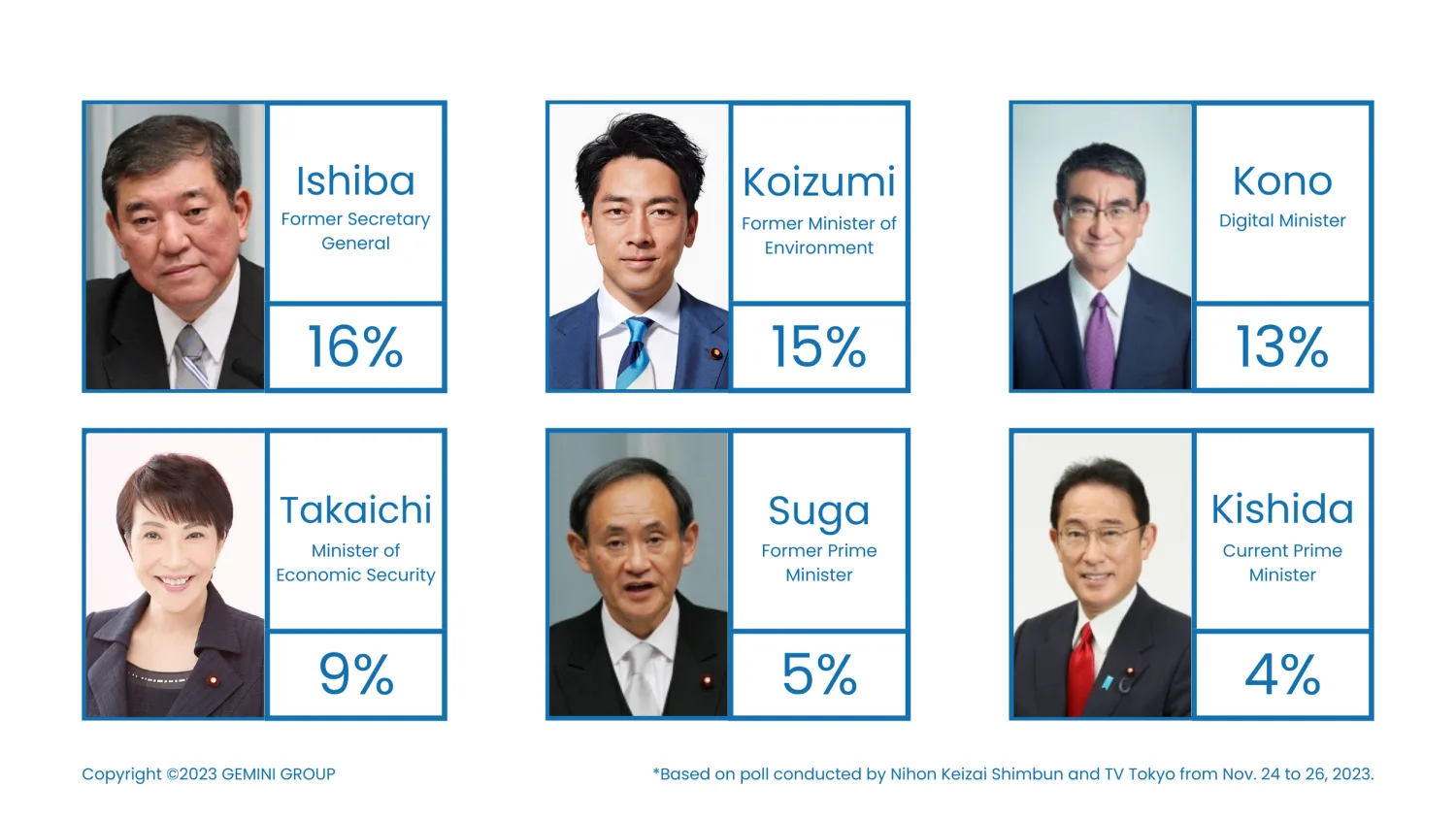
Opinion polls on who the public wants to lead the Liberal Democratic Party (LDP) rarely pick the eventual winner, the LDP presidency is decided by lawmakers and party members, not by the general electorate. But they do something more useful for government relations teams: they reveal the public mood that LDP power brokers ultimately cannot ignore. The Nikkei/TV Tokyo poll from late November 2023 is a textbook example, and the signal it sent foreshadowed the political cycle that followed.
Conducted between November 24 and 26, 2023, the poll showed Shigeru Ishiba, a perennial leadership contender and former LDP secretary-general, at the top of the field for “next prime minister.” Roughly ten months later, Ishiba won the LDP race and became prime minister. For foreign companies and industry associations reading these tea leaves, the episode is a reminder that structured polling is an early-warning system for policy direction in Japan.
Context note: Ishiba served as prime minister from October 2024 until Sanae Takaichi’s victory in the 2025 LDP leadership race made her Japan’s first female prime minister. The analysis below is framed as of late 2023 and treats the poll as a leading indicator, not a forecast.
What the Nikkei/TV Tokyo poll actually showed
The joint Nihon Keizai Shimbun and TV Tokyo poll surfaced a clear, if fragmented, field.
The top three
- Shigeru Ishiba, 16%
- Shinjiro Koizumi, former Minister of the Environment, 15%
- Taro Kono, then Digital Minister, 13%
Incumbent Prime Minister Fumio Kishida came in sixth at just 4%, a striking data point given that he still held the top job. The numbers confirmed what other late-2023 surveys were signaling: the public had lost interest in Kishida’s leadership well before the LDP’s own machinery caught up.
Why the split at the top mattered
A three-way cluster at 13 to 16 percent tells you two things. First, no single challenger had consolidated public backing. Second, the field was defined by figures who had each built a distinct public brand: Ishiba on defense policy and rural revitalization, Koizumi on climate and generational change, and Kono on administrative reform and digitalization. For public affairs teams, that diversity of platforms meant the eventual policy agenda could pivot sharply depending on which contender prevailed.
Reading the Ishiba signal for business
Ishiba’s lead in the public-facing polls did not guarantee victory inside the LDP. It did, however, carry real weight for any company building a multi-year government relations plan.
Ishiba’s policy fingerprints
Across multiple leadership runs, Ishiba consistently championed a handful of positions that have direct implications for foreign business:
- A more assertive defense posture and higher defense spending, with knock-on effects for defense procurement and the security-adjacent supply chain.
- Rural revitalization and regional economies, including friendlier treatment of small and medium enterprises outside the Tokyo–Osaka corridor.
- A willingness to re-examine monetary policy orthodoxy, introducing uncertainty into currency and bond-market assumptions.
- Openness to structural reform in agriculture and labor markets, though usually paired with caution on the pace of change.
Multinationals with exposure to any of these areas had reason to start scenario-planning in late 2023, well before the leadership race formally opened.
The experience premium
The poll results also communicated something about what the Japanese public wanted in a leader during a turbulent period: experience, steadiness, and a record of independent thinking inside the LDP. Ishiba’s profile matched that demand almost exactly. Koizumi, by contrast, polled strongly on generational renewal but carried less policy scar tissue. Kono polled on competence and modernization.
How to use public polling in your government relations playbook
Public polls are not the same as lawmaker whip counts, and treating them that way is how foreign companies get blindsided in Tokyo. But used correctly, they are a valuable input.
Polls as directional indicators
Japanese public polling on leadership preferences tends to be directionally useful even when it is numerically wrong. A candidate polling well often attracts more favorable media coverage, which in turn influences junior lawmakers weighing their endorsements. Over a multi-month cycle, that feedback loop matters.
Polls as stakeholder-mapping tools
Every named contender in a poll comes attached to a policy brain trust: advisors, favored think tanks, and sympathetic bureau chiefs. Mapping those networks early gives a public affairs program options if any of the contenders rises.
Polls as a check on LDP internal logic
The LDP’s internal decision-making is often driven by factional math that the public does not see. When public polling sharply diverges from what party elders appear to want, that gap creates pressure. The 2023 data, a sitting prime minister polling below 10% while Ishiba hovered near the top, helped set up the conditions that eventually made Kishida’s exit thinkable.
Lessons that still travel into 2026
Even though both Ishiba and Kishida are now out of office, the analytical frame from this episode remains usable.
Leadership volatility is the baseline
Japan has had four prime ministers between 2020 and 2025: Suga, Kishida, Ishiba, and now Takaichi. Any government relations strategy that depends on a specific PM staying in place is structurally fragile. Anchor your plan in ministries, bureaus, and advisory councils rather than in personalities at the very top.
Watch the pipeline, not just the podium
The figures polling second and third in any “next PM” survey are not noise. Koizumi now serves as Minister of Defense under Takaichi, having held Agriculture, Forestry and Fisheries under Ishiba. Kono has rotated through multiple senior roles. Today’s runners-up are tomorrow’s cabinet ministers, and building relationships with their teams early is low-cost, high-option-value work.
Keep a living LDP org chart
The LDP dissolved most of its formal factions in 2024 after the political funds scandal, but informal networks around figures like Ishiba, Aso, Motegi, and Takaichi continued to drive personnel decisions. A serious public affairs program in Japan maintains an internal, living map of these alignments and refreshes it after every major party election.
Why this matters for public affairs in Japan
Leadership polls in Tokyo are not a horse-race entertainment. They are a rolling, public-facing measurement of which policy direction the Japanese electorate is willing to accept, and the LDP ultimately has to price that in. Reading those signals early, and translating them into concrete stakeholder engagement, is what separates reactive government relations from strategic public affairs.
Gemini Group tracks LDP leadership dynamics, cabinet transitions, and the policy implications of political change for foreign companies operating in Japan. If you want a tailored read on the current cycle, contact us.