Japan's Autonomous Cargo Highways: The Auto Flow Road and the Future of Carbon-Neutral Logistics
How Japan's Auto Flow Road plan addresses the trucker shortage, carbon goals, and the 2024 logistics crisis, and what it means for public affairs and corporate strategy in Japan.
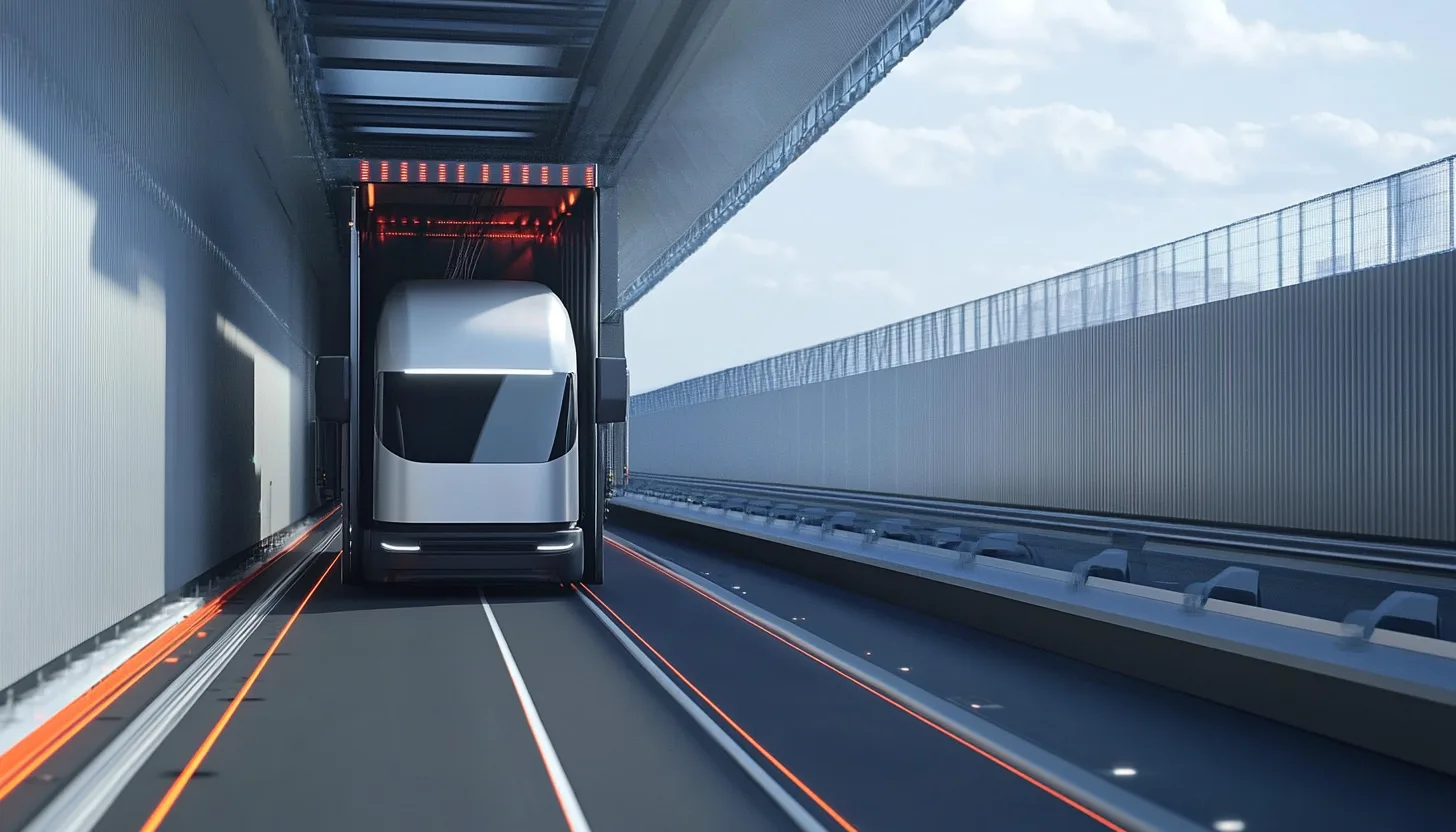
Japan’s logistics sector sits at the collision point of three trends: a shrinking working-age population, a statutory cap on truck-driver overtime, and a national commitment to carbon neutrality by 2050. In November 2023, the Ministry of Land, Infrastructure, Transport and Tourism (MLIT) formally unveiled its answer: the Auto Flow Road (jidou butsuryu doro), a dedicated autonomous cargo corridor designed to move freight between Tokyo and Osaka without drivers, without emissions, and without competing with passenger traffic.
For companies shipping into, out of, or within Japan, the Auto Flow Road is more than an infrastructure headline. It is a signal about where public policy in Japan is steering logistics procurement, labour standards, and corporate ESG obligations over the next decade.
Watch a simulation video produced by the Japanese government to see how the Auto Flow Road would work.
Why Japan needs the Auto Flow Road
Japan’s transportation sector is in the middle of a structural crisis. Since April 2024, new work-hour rules under labour-standards reform cap truck-driver annual overtime and mandate rest breaks. While the rules protect driver health, they also sharply reduce available transport capacity, a shift known in industry as the “2024 problem.”
MLIT has projected a potential 34% reduction in transport capacity by 2030 if nothing changes. Overlay that with a demographic curve in which the working-age population is shrinking roughly 0.7% per year, and a post-pandemic e-commerce sector still growing in volume, and the arithmetic does not work. Trucking cannot recruit and retain its way out of the problem.
Against that backdrop, the Auto Flow Road is Japan’s attempt to engineer a new kind of corridor entirely, one that does not depend on human labour at all.
How the Auto Flow Road will work
The Auto Flow Road is not a conventional highway. It is a dedicated autonomous lane for standardised cargo pods running 24 hours a day, seven days a week, either enclosed in glass tunnels alongside existing highways or routed underground.
Each pod is designed to sort itself, communicate with depot systems, and pause in a designated buffering lane to synchronise with other cargo headed to the same destination. In practice, the corridor itself acts as a continuous rolling buffer, reducing the need for large warehouse footprints at each end. That is a structural shift in warehousing economics as much as it is a transportation play.
By standardising pallets at 1.1 metres by 1.8 metres, MLIT is also nudging the wider industry toward a single dimensional standard, which has downstream consequences for packaging, forklift procurement, and warehouse fit-out.
Integration with depots and last-mile delivery
At major depots along the corridor, automated forklifts will load and unload cargo between the Auto Flow Road, trucks, rail, ports, and airports. The architecture is explicitly intermodal: the goal is not to replace trucking, but to take linear, long-haul volume off the highway so human drivers and autonomous vehicles can concentrate on shorter, higher-value last-mile trips.
For the last mile, MLIT envisages a mix of trucks, drones, and autonomous delivery vehicles feeding off the depot network. Several of those technologies are already being tested under Japan’s regulatory sandbox framework, creating a pipeline of pilots that could plug into the Auto Flow Road once it is operational.
Environmental and economic impact
Transportation accounts for roughly 19% of Japan’s greenhouse gas emissions, with freight a meaningful share of that total. The Auto Flow Road is designed from the outset for carbon-neutral operations, drawing on low-carbon electricity and eliminating the diesel-engine footprint of the trucks it displaces.
Economically, MLIT has estimated the system could replace 12,000 to 17,000 human-driven truck trips per day between the two metropolitan corridors. The projected construction cost of roughly 3.7 trillion yen is substantial, but needs to be read against the productivity losses Japan is already absorbing under the 2024 driver-hour rules, plus the avoided capital expenditure on warehouses, trucks, and emissions compliance that pod-based logistics would make unnecessary.
Policy context and timeline
MLIT aims to build a test track on the Tokyo–Osaka corridor, Japan’s busiest logistics artery, with trial runs targeted for 2027 and full operation projected for the mid-2030s. If the corridor proves viable, expansion to other major routes is on the table.
The government has explicitly invited private-sector participation in design, construction, and operation. That matters for public affairs and government relations in Japan because it is a standing signal that MLIT wants foreign and domestic firms at the table on specifications, safety standards, and interoperability, decisions that will lock in technology choices for decades.
Several ministries have equities here beyond MLIT. METI’s interest lies in industrial competitiveness and export potential for the technology stack. The Digital Agency is relevant for the data, communications, and cybersecurity layers. MHLW’s labour-standards rules are the forcing function. Coordinated public policy in Japan on autonomous logistics will ultimately require alignment across all of them.
What this means for companies operating in Japan
Logistics-exposed companies (retailers, e-commerce platforms, manufacturers, 3PLs, and warehouse operators) should treat the Auto Flow Road as a planning assumption, not a speculative headline.
- Procurement horizons are shifting. Warehouse leases, fleet renewals, and packaging standards signed today should anticipate a partially automated corridor by the mid-2030s.
- Standards are being set now. Pallet dimensions, pod specifications, depot interfaces, and data protocols are all open questions where early engagement with MLIT working groups and industry associations can influence outcomes.
- Regulatory sandbox pilots matter. Autonomous delivery technologies tested under the sandbox framework are part of the ecosystem that will feed into the Auto Flow Road’s last-mile layer.
- ESG reporting gets easier. For Japan-based operations, shifting long-haul freight onto a carbon-neutral corridor is a Scope 3 story that will be increasingly important to investors and customers.
Why this matters for public affairs in Japan
The Auto Flow Road is the clearest example yet of how Japan is responding to demographic and climate pressures with engineered, state-led infrastructure rather than pure market signals. For foreign firms and trade associations, that means the relevant conversation is not just with customers. It is with MLIT, METI, the Digital Agency, and the Diet committees overseeing transport and industrial policy.
Gemini Group works with clients in logistics, mobility, and supply-chain technology to map stakeholders across these ministries, engage with standards-setting processes, and position commercial offerings against Japan’s infrastructure roadmap. Contact us to discuss how your organisation can engage with the Auto Flow Road and the broader decarbonisation agenda in Japanese logistics.