Japan's Seventh Basic Energy Plan: Nuclear, Hydrogen, and the Commercial Stakes for 2035
Inside Japan's Seventh Basic Energy Plan: nuclear restarts, hydrogen, offshore wind, GX financing, and what it means for public affairs and corporate strategy in Japan.
Japan’s Basic Energy Plan is the single document that anchors every significant commercial decision in the country’s power sector. It shapes procurement assumptions for utilities, the investment thesis for renewables developers, the licensing timeline for nuclear operators, and the business case for hydrogen, ammonia, and carbon capture projects. The Seventh Basic Energy Plan, drafted by METI’s Agency for Natural Resources and Energy and approved in early 2025, is the roadmap under which the industry is now operating as of 2026.
For corporate affairs teams and foreign investors active in Japanese energy, the Plan is effectively the master reference for public policy in Japan on decarbonisation, energy security, and industrial competitiveness. Understanding what changed, and what did not, is essential.
The energy trilemma, restated
Japan continues to frame its energy paradigm around three pillars: energy security, sustainability, and affordability, the so-called energy trilemma. As a densely populated island nation with limited usable land, constrained fossil-fuel endowments, and a post-Fukushima nuclear legacy, Japan cannot optimise for one pillar without trading off the other two.
The Seventh Plan preserves that structure but reweights it. Energy security has moved higher in the stack since Russia’s invasion of Ukraine exposed LNG dependence, and industrial competitiveness, particularly the cost and reliability of power for semiconductor and AI data-centre demand, is now treated as a first-order concern alongside the 2050 carbon-neutrality commitment.
Short-term objectives: innovation in renewables
The Plan’s short-term horizon focuses on commercialising next-generation renewable technologies where Japan has a credible industrial position.
Perovskite solar cells are the flagship. Their thin, flexible form factor allows installation on building facades and other surfaces unsuitable for conventional silicon PV, a critical advantage in land-scarce Japan. METI and NEDO have accelerated demonstration projects with a goal of domestic mass production by the late 2020s.
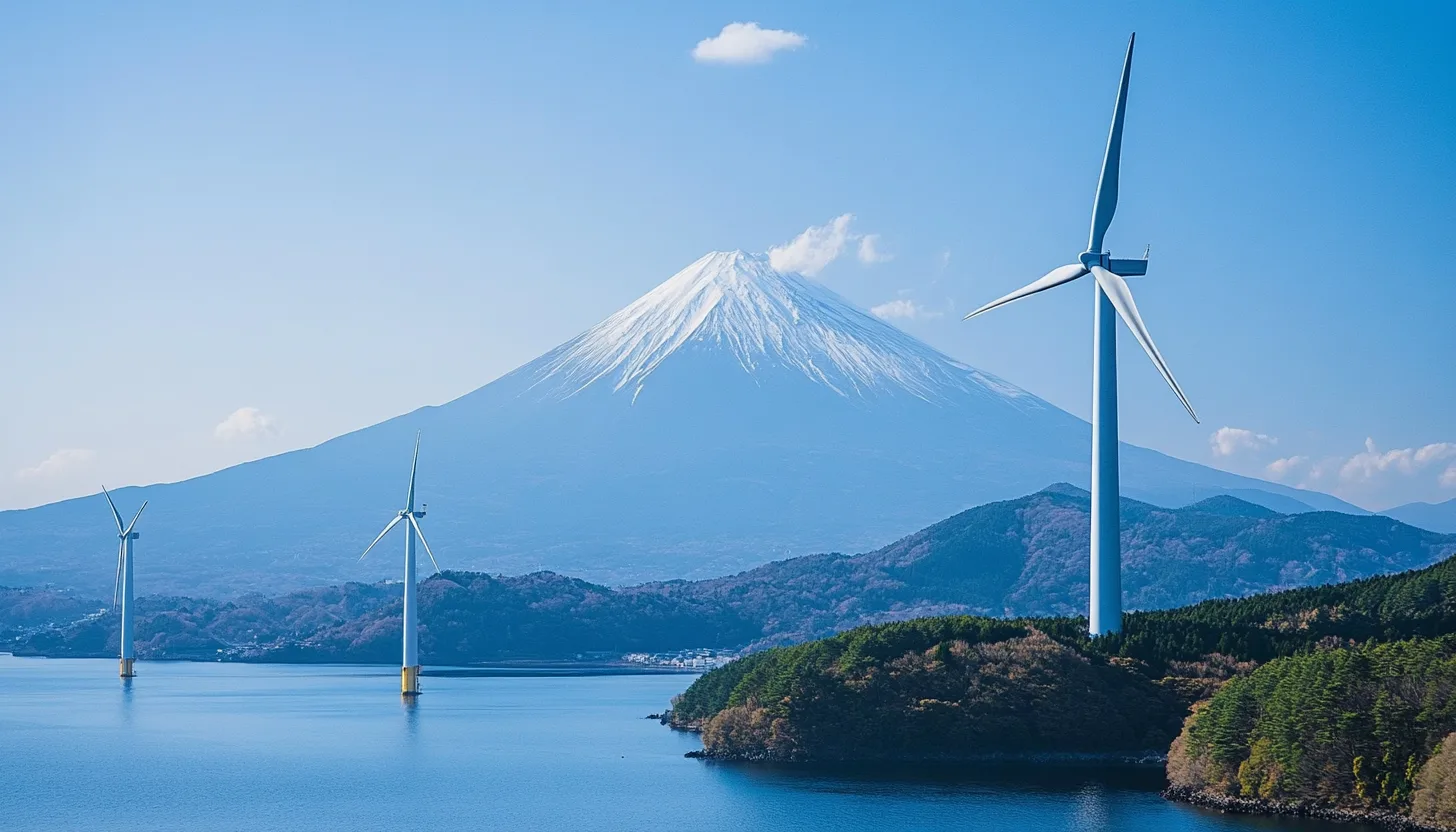
Floating offshore wind is the second priority. Japan’s deep continental shelf makes fixed-bottom offshore wind unviable across most of its waters. The government is backing floating platforms as both an energy solution and an export industry, with dedicated auction rounds and infrastructure investment through the mid-2030s.
The commercial question is whether these technologies can scale from pilot to utility-scale economics within the Plan’s timeframe. That transition is where government relations in Japan becomes decisive, because subsidy design, grid-access rules, and local-content expectations are all still being negotiated.
Medium-term objectives: infrastructure and transition fuels
The medium-term horizon addresses the gap between current generation capacity and the fully decarbonised grid of the 2040s.
Japan plans major transmission-line expansion to move renewable power from generation-rich Hokkaido and Tohoku to load centres in Kanto and Kansai. Grid constraints have been the single largest bottleneck to renewable deployment, and the Plan commits to resolving them.
On the generation side, co-firing coal with ammonia and natural gas with hydrogen is positioned as a transition strategy, keeping thermal capacity on the grid while progressively lowering its carbon intensity. Critics argue this extends the life of fossil assets; METI argues it preserves dispatchable capacity during the ramp to full decarbonisation. The policy debate matters commercially because it determines whether existing thermal fleets are stranded or retrofitted.
In transport, sustainable aviation fuels (SAF) and biofuels are the focus for hard-to-electrify modes, with domestic production targets backed by tax incentives and procurement mandates.
The role of nuclear power
Nuclear is the Plan’s most politically sensitive element and the one most relevant to Japan’s industrial competitiveness. As of 2026, roughly 14 of Japan’s reactors have returned to commercial operation since the Fukushima shutdown, with more in various stages of safety review. The Seventh Plan commits to restarting the majority of remaining reactors and extending the operational lifetime of existing plants, steps already enabled by legislative changes to the nuclear reactor regulation framework.
The construction of new reactors remains contested. Takaichi’s government has signalled openness to next-generation reactors, including small modular reactors (SMRs) and advanced light-water designs, to replace decommissioned capacity, but parliamentary arithmetic under the current coalition landscape makes any rapid legislative push difficult. Anti-nuclear parties, including the CDP, continue to hold meaningful Diet leverage.
For operators, suppliers, and foreign technology partners, the practical implication is that nuclear is back in Japan’s power-supply story but at a pace set by political consensus, not engineering timelines. Commercial planning needs to price in that uncertainty.
Hard-to-abate sectors and carbon removal
Reducing emissions from industrial manufacturing, steel, chemicals, and long-haul transport remains the hardest part of the Plan. The Seventh Plan expands the policy toolkit to include:
- Hydrogen and ammonia as feedstock and fuel, backed by procurement mechanisms designed to bridge the cost gap with fossil alternatives.
- Carbon capture and storage (CCS), with demonstration projects under way and commercial deployment targeted for the late 2020s.
- Carbon removal, including direct air capture (DAC) and biomass energy with CCS (BECCS), acknowledging that emissions reduction alone will not close the gap to net zero.
Given Japan’s limited domestic geology for CO2 storage, many of these projects will be executed abroad, with credits imported. That makes regional cooperation not optional but structural.
Regional collaboration across Asia
Japan’s energy strategy is explicitly regional. The country will continue to rely on LNG imports from Australia, Malaysia, and other partners while building out bilateral frameworks for hydrogen and ammonia supply. Southeast Asia is central: CCS partnerships with Malaysia and Indonesia are developing dry wells and depleted oil fields as CO2 storage sites, and joint-credit mechanisms offer Japanese firms a pathway to count overseas emissions reductions toward domestic targets.
For Japanese trading houses, utilities, and engineering firms, Southeast Asia’s growing energy demand is as much a business opportunity as a policy dependency. Foreign firms with technology in hydrogen electrolysis, CCS, grid management, or SMRs should expect to engage with both Japanese partners and the intergovernmental frameworks that underpin these projects.
Financing the transition: the GX Transition Bond
The Plan is paired with a serious financing architecture. Japan has issued GX Transition Bonds, climate-transition bonds, to raise approximately 20 trillion yen over a decade to support hydrogen, ammonia, CCS, and other decarbonisation projects. Carbon pricing mechanisms began phased introduction in 2026, with a fossil-fuel surcharge on importers and the groundwork for an emissions-trading system covering major emitters.
Together, GX bonds and carbon pricing create the revenue stream and the cost signal that make the Plan’s longer-term bets financeable. For companies, the practical effect is clearer: decarbonisation investments now have both subsidy support on the upside and emerging cost pressure on the downside.
What this means for companies operating in Japan
The Seventh Basic Energy Plan is not a static document; it is the backbone against which METI, the Cabinet Office, and the Diet are shaping ongoing regulatory decisions through 2026 and beyond.
- Power procurement assumptions are shifting. Large industrial consumers (particularly data centres, semiconductor fabs, and manufacturers) should map their power-purchase strategies against the Plan’s nuclear, renewable, and grid timelines.
- Subsidy and procurement windows are opening. GX bond-funded programmes are still being allocated across hydrogen, SAF, perovskite, offshore wind, and CCS. Early engagement shapes eligibility.
- Carbon pricing is now a planning input. Scope 1 and 2 emissions in Japan carry an emerging price signal; long-term capex should reflect that.
- Stakeholder maps must include the Diet. With nuclear and fossil co-firing politically contested, policy engagement cannot stop at METI.
Why this matters for public affairs in Japan
Japan’s energy transition is being executed through a rare combination of strong central planning, large-scale public financing, and contested parliamentary politics. That combination rewards companies that engage early with both the technical ministries and the political actors shaping the Plan’s implementation.
Gemini Group works with energy, industrial, and technology clients to interpret METI policy signals, track Diet dynamics on nuclear and carbon pricing, and build engagement strategies that hold up across Japan’s shifting political landscape. Contact us to discuss how your organisation can navigate Japan’s Seventh Basic Energy Plan and the commercial opportunities it creates.